Posts

Showing posts with the label Iraq

SENIOR U.S. SENATE DELEGATION, MARYAM RAJAVI MEET IN TIRANA, THE ALBANIAN CAPITAL

Image
Masoud Dalvand –TDO- (AMERICA)  On Saturday, August 12, 2017, a senior delegation from the United States Senate meet with Maryam Rajavi, in the Albanian capital, Tirana, and discussed the situation of the members of the People’s Mojahedin Organization of Iran (PMOI/MEK) in Albania, the latest developments in Iran and the Middle East as well as solutions to end the current crisis in that region. The Senate delegation was comprised of Senators Roy Blunt, Vice President of the Republican Conference, and member of the Appropriation, Select Intelligence, Rules and Administration, and Commerce, Science, and Transportation Committees; John Cornyn, the Majority Whip, and a member of the Judiciary, Select Intelligence, and Finance committees; and Thom Tillis, a member of the Armed Services, Judiciary, Banking, Housing and Urban Affairs and Veterans’ Affairs committees. The meeting, at one of the centers of the MEK in Albania, was initiated by Senator Roy Blunt, as the delegation was ...

Iran Regime Change: A New War or Preventing One

Image
The bipartisan passage of the sanctions bill  H.R. 3364  by both houses of Congress, and the Trump administration’s approach to Iran have raised questions over the right policy toward Iran. Meanwhile, a  grand gathering  of Iranians in Paris suburb on July 1 st  with 100,000 participants, recited the desire of millions of Iranians: regime change. Accordingly, Iran apologists, concerned that the appeasement policy is coming to an end and the new administration may adopt a policy of regime change, have become active to portray this bloody picture that such a policy will drag America to another Middle East war. To prove their point, they refer to the US-led invasion of Iraq or the Libya regime change campaign. Due to catastrophic consequences of Iraq’s invasion for the US and the region, this reasoning could convince many Americans that regime change policy is not the right policy. Nonetheless, this comparison is merely aimed at exploiting a wrong policy...

ANALYSIS: How to tackle Iran’s Middle East bellicosity

Image
Thanks to years of Western appeasement in the face of Iran’s belligerence across the Middle East, evidence of Tehran’s dangerous footprints are now visible in several countries across the region, including even Saudi Arabia’s Eastern Province. The Trump administration, however, has made it quite vivid its adoption of a firm approach. This stance, signaled in the historic May conference in Riyadh, is long overdue and should be enhanced by Washington supporting the Iranian people’s desire for  regime change . A history of devastation Iran has a long record of hostility against neighboring countries and US interests in the Middle East. The 1983 bombings targeting the US Embassy and barracks in Beirut, the Khobar Towers attack in 1996, all climaxed in the support Iran provided for Shiite proxies and the Sunni Taliban in their campaign against US-led coalition forces in Afghanistan and Iraq. In parallel form, the Lebanese Hezbollah and Hamas, two known terrorist groups, have ...

New sanctions show US sides with Iranian people, not the regime

Image
Last week, the “Countering Iran’s Destabilizing Activities Act of 2017" received a rare and near unanimous bipartisan vote in Congress. The legislation placed more sanctions on the Iranian regime. It called for extending terrorism-related sanctions on the notorious Islamic Revolutionary Guard Corp (IRGC), Iran’s violators of human rights and its missile program, which is increasingly threatening world peace.  It was signed into law  earlier Wednesday. This coincided with the second anniversary of the Iran nuclear deal. President  Donald Trump  has appointed a team in the White House to figure out how to deal with the agreement, but his administration has also correctly pointed out that the broader implications of that deal have by no means been positive. ADVERTISEMENT Critics of the Obama administration’s conciliatory Iran policy understood that when sanctions relief was narrowly focused on the nuclear issue, Iran would be emboldened in other areas. They ...

The Right Solution For Iran Is Not War

Image
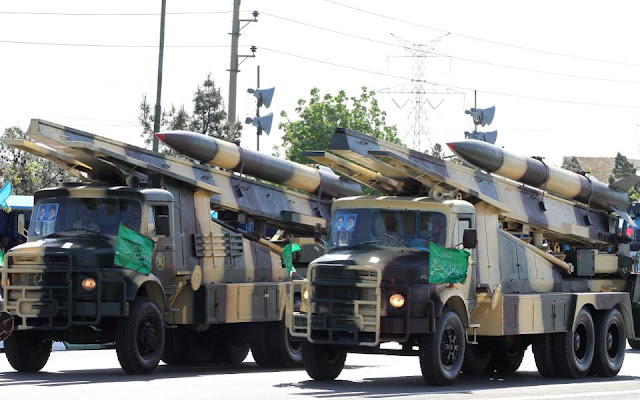
Iranian military trucks carry surface-to-air missiles during a parade on the occasion of the country's Army Day, on April 18, 2017, in Tehran. / AFP PHOTO / ATTA KENARE (Photo credit should read ATTA KENARE/AFP/Getty Images) We are at a critical juncture in our time in history. The  Iran nuclear deal , known as the Joint Comprehensive Plan of Action (JCPOA), has entered now its third year. As the Trump White House is pending its Iran policy there is increasing support for regime change. All the while the Iran appeasement camp are boosting their efforts of claiming any firm policy on Tehran will lead to war. The question is do the measures professed by this party truly prevent war? When Iranian opposition National Council of Resistance of Iran (NCRI) recently held its  annual convention  in Paris, with Trump “emissaries” such as former New York Mayor Rudy Giuliani and former House Speaker Newt Gingrich speaking powerfully of regime change in Iran. Forme...

Understanding IRGC’s long-term goals in Iraq

Image
“I announce from here the end and failure and the collapse of the terrorist state of falsehood and terrorism which the terrorist Da’esh (ISIS) announced from Mosul,” the Iraqi Prime Minister declared on state television recently. Following a three-year long blitz, Iraqi forces with the support of the international coalition, have now defeated ISIS in Mosul, despite all challenges and sectarian disputes. But the defeat of ISIS has created a vacuum and there are some hard questions about Shi’ite militias such as the People Mobilization Units (PMU) that must be answered. This is particularly important because the PMU was established because of the sectarian divisions in Iraq.   Hamid Bahrami But what role will the PMU play in the future of Iraq? Who will control and command the PMU? It is a known fact that some Shi’ite militant groups in Iraq – such as the Kata’ib Hezbollah, Badr Organization and Asa’ib Ahl al-Haq – are supported by Iran’s Islamic Revolutionary Guard Corps...

ANALYSIS: How to protect Iraq from Iranian influence

Image
With the recapturing of Mosul, the rein of ISIS in northern Iraq is coming to an end. This, however, can lead to the reemergence of a far more dangerous threat for the future of this fledgling democracy. Iran and its destructive meddling Mesopotamia has devastated this entire nation, leaving at least tens of thousands killed, scores more wounded, injured and displaced. Tehran has continuously targeted the Sunni community in Iraq and taken advantage of the war against ISIS to change the very fabric of this minority. Sunni provinces have been the target of this wrath especially after Nouri al-Maliki, described by many as Iran’s puppet in Iraq, reached the premiership in 2006. Dark history Ever since 2003, with a surge beginning under al-Maliki’s watch, Iran has flooded its western border neighbor with financial, logistical and manpower resources, spearheaded by the Revolutionary Guards (IRGC). The track record of Iran-backed proxy groups and  death squads in Iraq ...

Why IRGC is enemy of Islam and a major source of terrorism

Image
In 1979, after decades of oppression, people in Iran courageously stood up to the Shah dictatorship and demonstrated power of the people by toppling him. But their hopes of freedom were soon crushed when Khomeini was able to deceive them with false promises to establish a bloody reign of terror, based on a state principle called velayat-e-faqih. We must not be deceived by media outlets, which try to compare Iran’s state principle to other countries in the region. Velayat-e-faqih means that the faqih, a so-called Islamic jurist, is the custodian of all Muslims until the missing 12th Imam Mahdi reappears. By nature, he must rule not only people in Iran but Muslims all over the world and has the divine duty to give global fatwas and intervene into other nations to “free” them. This is manifested in the preamble of the Iranian constitution of 1979 when it says: “[T]he Army of the Islamic Republic of Iran and the Islamic Revolutionary Guards Corps (IRGC) […] will be responsible not o...